

B of Briz is an alternative hip-hop artist from Bristol. She released her debut EP in 2022 and subsequently won the ‘Future Sound of Bristol’ Competition in April 2023. She’s set to release her debut album later this year, with the first single, The Man at the Party, released in May.
Ahead of its release, she told us more about her approach to music; from working behind a mask to carving out a niche in hip-hop.
You’re self-described as weird-ass, feminist rap. What’s so weird about your music?
Ha, I think one of the ways it’s weird is my comfort with imperfection. Y’know that phrase – ‘perfect is the enemy of good’? I’ve really tried to embrace that with how I’ve approached music.
There’s going to be people with better flows and cadences, more polished or impressive performances, totally perfect production values. There’s also people with absolute opuses on their hard drives, being perfected by otherwise silent artists for decades. And that is what it is.
But this is what I’m doing – the result is somewhat lo-fi, an extremely raw and real vocal, but interesting, and with a genuine conviction that what I’m saying might be useful and important.
One of the things about starting this journey in music so late, is I don’t have the luxury of unfurling this slowly in that way. I hope I’m still doing it in a thoughtful and considered way, though!
You deliberately keep your identity anonymous, what’s your thinking behind that?
There’s a couple of parts to it – my artist name and my mask. The mask was definitely partly about the horribly damaging beauty standards of the music industry. I’m in my forties, I’m not someone who wears make-up. I’m not interested in playing that game (and would lose if I did!)
Plus it’s an iconic look – which I think is important for artists to stand out. My plan is to have a different mask for each release.
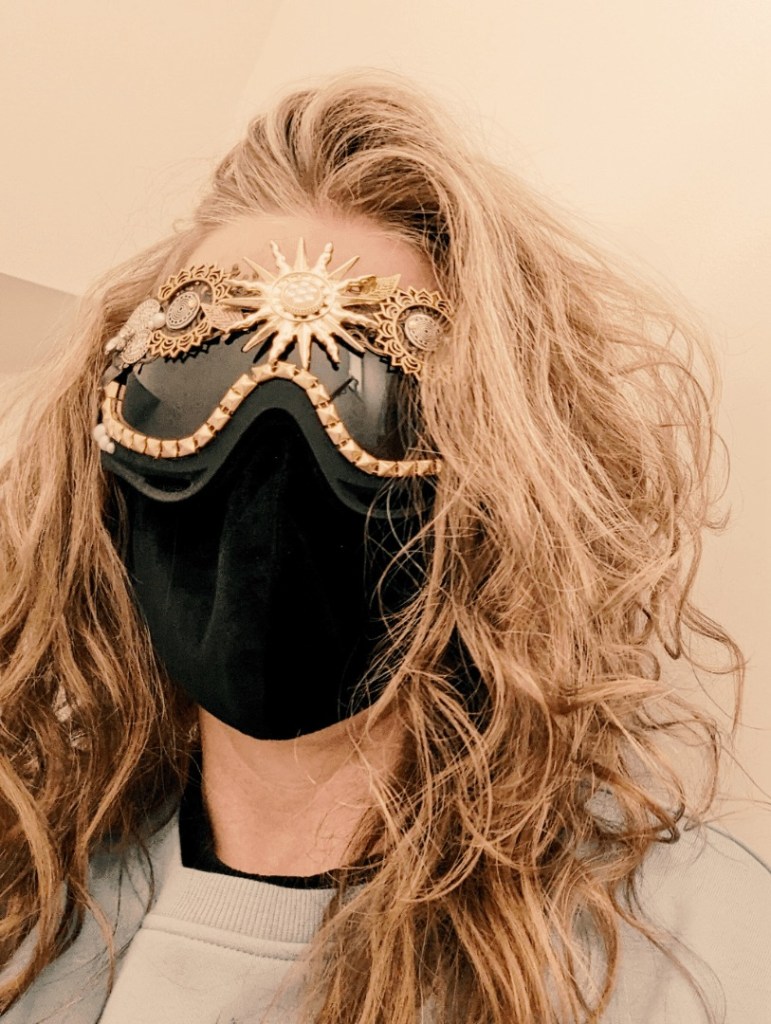
Do you think the anonymity impacts your writing at all? Does it give you more freedom or does it potentially limit how personal you can be?
I think making music pseudonymously makes me feel much freer to say what I want – it gives me a sense of artistic and authorial freedom that I might not feel making music under my own name. It allows me to make work that’s bolder, braver and more personal, rather than less.
Despite the anonymity, there’s some clues in there about you. The Briz in your name is for Bristol. Was that just some convenient alliteration or do you see Bristol as a key piece of who you are?
I grew up in a town nearby in the West Country, moved to Bristol in my early twenties for my PhD, and I definitely feel like this place is part of me. And B as a musical persona is one that’s indelibly tied up in Bristol, almost all of my live musical experiences have been here, and I’ve met so many people here with a deep and abiding love of music, people who prioritise music in their lives in various ways.
The other thing is that I loved Bristol music as a teenager. Seeing trip-hop and DnB legends like Roni Size blow up, and become internationally recognised and pulled into the mainstream, made me see local music as this urgent, relevant force in the world.
I asked this question to Durham-based “sincerity rapper”, Faithful Johannes, and I’m interested in your take. As a late starter in music, and a white British female doing rap, is there any sense that you need to justify your own niche (e.g. feminist rap)?
In a word, yes! Look, hip-hop is a part of black culture. It was born out of the civil rights movement. If white people want to participate in the form in a meaningful (and non-appropriative) way, then their work needs to first of all be predicated on an anti-racist commitment, but also needs to build on the same foundation – a sense of anger born of injustice and inequality that hip-hop is rooted in, or the emancipatory and radical power of black joy (or the equivalent for their marginalised group).
I see feminism as an emancipatory philosophy, just like anti-racism, and the systems of patriarchy and white supremacy as intertwined and interdependent. So that’s partly why I see what I do as hip-hop, and how I see my contribution to it.
In terms of being a late starter, that’s an interesting question. I think there’s a lot of biases to youth in creative work, mainly due to notions of ‘genius’ and ‘raw talent’ (aside from the aesthetics of youth, and the vulnerability of young people in business). But I think both those notions are kind of bogus – narratives of art perpetuated by the powerful. I think life experience, consistency, applied effort are just as important as ‘talent’ in creating meaningful work – and those are more often (although certainly not exclusively) found in older artists.
When you label yourself as a feminist rapper, there’s an obvious connotation that you’re making music with “A Message”. I’ve heard different views on this, and I remember a quote from a “political” band that music can’t really change anything. What’s your view on that? Beyond the artistic expression, do you think music can really make an impact?
Listen, I wouldn’t be doing this if I thought that art is politically inert in that way. Tom Robinson has been a big supporter of mine on BBC Radio 6 Music, and his career and contributions to music over the years I think prove that music can shift things. ‘Glad to be Gay’ is an anthem of Pride for a reason, and the ‘Rock against Racism’ movement (which the Tom Robinson Band were part of) was a real part of the ongoing development of anti-racism in Britain.
And to bring that to your music; when you write a song like The Man at the Party, which is like a call-out of toxic masculinity, who do you see that song as being for?
That’s a really interesting question. I see it as being mainly for other women. The whole album this single is from is about toxic masculinity and men’s misogyny from a woman’s perspective. So I’m talking about the view from over here. Obviously I do hope that men will find something useful in hearing about how things seem to us!
But this song is about a woman’s experience – I hope I’m articulating women’s experience of, and thoughts about, these ideas of Patriarchy in ways that are useful to women. So much of the marginalised experience is gaslit or straight-up denied, that just hearing someone talk about it in new ways can be cathartic and illuminating and affirming and powerful.
Time for the shameless plug. You’ve got a new single coming out and your debut album lined up. What can people expect from them?
Yep, my single, The Man at the Party, is out 29th May, and I’m gonna be dropping all sorts of singles over the summer, before releasing my album in October.
This is music about important shit, but it also has a sense of humour. It’s confrontational but also conciliatory. Musically, this is beat-driven, bass-driven alt hip-hop with trip hoppy vibes and some classical influences. If you love some Phillips Glass, and you’re also into Portishead, and you’ve enjoyed Kae Tempest’s work, you’ll be in the right place!
The Man at the Party, plus B of Briz’s 2022 debut EP, Forty-Two, are available to stream now.
Find her on your chosen social media/streaming services via the links here.
Photo credits: Inshot Media & B of Briz
More from No Frills Reviews
 No Frills Reviews
Leave a comment