
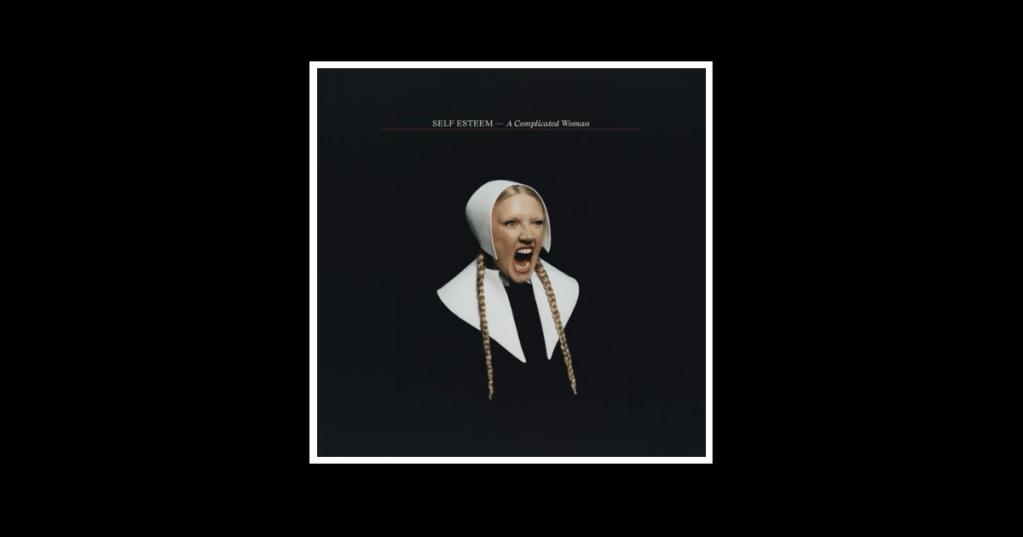
There’s hints of pop greatnesss as Self Esteem makes her stadium-sized ambitions clear, but it slips into a caricature version of her best work.
After the success of 2021’s Prioritise Pleasure, Rebecca Lucy Taylor aka Self Esteem found herself as something close to a bonafide popstar (albeit one that’ll still get pigeonholed as ‘alt-pop’, largely by virtue of being a mid-30s woman). She’s spoken of the internal conflicts that came in its wake, her aspirations to diversify, and even thoughts of quitting music. A Complicated Woman feels like it captures someone not quite sure of what they wanted to do next, but now with a major label contract to fulfill. The solution has been to go bigger; unfortunately, it’s often to detrimental effect.
This very much feels like the prototypical major label debut; one that’ll have any self-respecting music snob proudly proclaiming that they “preferred their earlier work”. It takes some of the best elements of Self Esteem’s music, smooths out the edges and enhances them to overblown extremes. Even the album’s title feels like an on-the-nose distillation of the Self Esteem brand, as dreamt up by some marketing exec stereotype – “She’s confident, she’s empowered, she’s sex positive. But she’s also vulnerable, self-deprecating, and unlucky in love. She’s A Complicated Woman! It’ll be like Brat for people at the other end of their 30s.”
Taylor has explored acting in the last few years, and even developed a theatre experience to accompany A Complicated Woman. And the album is probably more appropriately viewed as something akin to Self Esteem: The Musical. An elaborate stage production, where every story beat is hammered home with the subtlety of a gospel choir.
We have to talk about the choir. It’s not as though Self Esteem’s music was particularly subtle in the first place. The earnest monologues and the rousing gospel-style backing vocals have always been there. But they’re over-employed here to the point of tedium. Their use often feels cynical; designed to create big emotional payoffs that haven’t particularly been earned. But, for all of my own cynicism, there’s plenty of good moments here; it’s just that they frequently get lost in the production choices.
The tone is immediately set with I Do And I Don’t Care. Taylor’s lyrics are engaging, funny, and touching, as she spells out the contradictions at the heart of the album; not concluding with overt girl-boss, self-help platitudes, but with the notion that she’s comfortable with just being okay. Yet it all seems a bit misplaced. As it dramatically builds across 5 minutes into the stirring, choir-assisted finale, it’s like a metaphoric premature ejaculation; the climax for something you haven’t really had the chance to experience. It sounds like it should have been closing the album. The sequencing, generally, feels sloppy. The powerful, orchestral ballad, Focus Is Power, is one of the highlights; getting the balance of self-empowerment grandiosity just about right. But the subsequent jump to the dubby pulse of Mother is jarring. I suppose a messy and confusing album is a fitting artistic statement given the title, but it serves to undercut the significance of key moments.
Mother and 69 see Taylor venture into sound-bite electro-pop, which seems primarily concerned with potential virality as it revels in it’s own quirkiness over bang-average house beats; the sort of thing that’s typically the forte of modern-day hipster clowns, like The Dare. The matter-of-fact smut of 69 should be fun, but the spoken-word delivery on these tracks gives them an air of self-satisfied self-importance, making them come across as try-hard novelties. One of the album’s best moments is Cheers To Me; the kind of wry breakup anthem that Taylor excels at, which is no doubt assisted by its relatively limited use of that choir. Amongst all the pomp, it’s a rare slice of unforced fun.
The most common flaw is that tendency towards theatrical pomp. The Curse is close to being one of the best songs she’s ever done, but the last minute or so seems completely superfluous. There’s multiple occasions where songs come to a somewhat natural conclusion, only to be stretched out for another 1-2 minutes so the choir can do its thing; tipping them into overwrought excess. As individual songs, this is more forgivable, but within the context of the album it quickly becomes tiring.
The features of Moonchild Sanelly and Nadine Shah are refreshing; taking the album into darker, moodier territory and offering a change of pace into the relatively low-key. Sanelly, in particular, conveys both a universality and uniqueness to what it means to be A Complicated Woman as she lays out her own experiences. It’s far more powerful than yet another grand finale. Introducing the voices of different women feels like an avenue that could have been explored more; it makes me wish they’d saved some of that choir budget to spring for a couple more features instead.
Taylor has referenced football highlights package music as a key influence/aspiration, and that may just sum up the problem with A Complicated Woman. This is music that too often feels cynically contrived to construct emotional moments, but in doing so, it actually undermines its emotional resonance. It’s still evident that Taylor is an occasionally excellent songwriter, but chill out with the choir fetish FFS.
Rating:

Best tunes: Focus Is Power, Cheers To Me, In Plain Sight (feat. Moonchild Sanelly)
More Reviews

SABLE, fABLE
People Watching
 No Frills Reviews
Leave a comment