
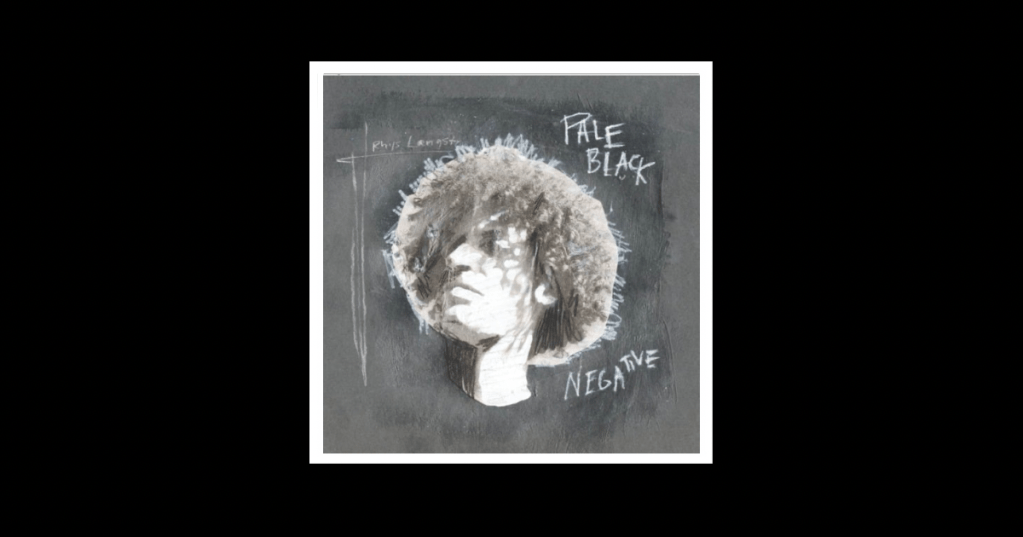
A boundary blurring opus as Langston’s lyrical flair is met with an emotive immediacy, amidst inventive, convention-defying compositions
Pale Black Negative is ostensibly an underground hip-hop record. But it wouldn’t be too far-fetched to call it a jazz or an R&B album. It’s also kind of art rock, and pop, and experimental . . . and you get the picture. LA rapper, Rhys Langston, has described this as a “rapper’s singer-songwriter record”, and it’s certainly one where he fully flexes his extensive talents as a rapper, singer, producer, and multi-instrumentalist.
I’ve contemplated how exactly to suitably describe Pale Black Negative, and that’s perhaps just as Langston intended. He refers to himself as a genre abolitionist. The tinge of grandiosity in that phrasing being very much deliberate. Langston contends that the confines of genre, like any other societal construct, seek to restrict along the boundaries of race, class, sexuality, etc. It’s why many black artists will inevitably be pigeonholed into the hip-hop box, regardless of their range of styles and influences.
Genre abolition is about breaking out of these boxes, but also about questioning what the boxes represent in the first place. Langston has opined that even so-called experimental music can come with its own restrictive expectations. Personally, I think experimental is too often just used as a synonym for ‘can’t write a hook’, so I concur. And that’s another restriction that Langston bypasses here. Genre fluidity is nothing new for him, but his 20th project is his most expansive and experimental yet, while also being his most accessible as he embraces his pop instincts.
With his thesaurus-like vocabulary, Langston’s lyrical dexterity can border on the impenetrable, particularly when the musical accompaniment leans more abstract. But here, he matches the verbose wordplay with his most emotionally resonant performances to date. He finds that resonance in the relative simplicity of a good melody or as his voice strains to hit an ambitiously high falsetto. He complements the verbosity by tapping into something far more primal.
That’s not to undersell his lyricism. He deals in a kind of linguistic psychedelia; utilising familiar phrasing before veering off onto winding detours, hypnotically multiplying entendres as he piles layer-upon-layer of abstract expressionism. He certainly doesn’t lend himself to easy interpretation, but that makes it all the more impactful when he opts for relatively unvarnished wording. As he does on the title track, recalling a life-altering teenage sport injury; amidst a barrage of elaborate verbiage, it’s a stark flash of vulnerability.
There’s something inherently ridiculous about Langston’s use of language. He’s ostentatiously ornate, yet his delivery often carries an air of casual mischief that manages to playfully undercut the bombast. There’s no way that he should be able to make a viable chorus of “Ate the tuning fork while I taxied in the crepuscular”, or that a hook of “I’m a page turner on the clarinet and bass” has any right to go as hard as it does. He’s not exactly delivering punchlines, but there’s undoubtedly a comedic element to Langston’s work. Perhaps most evident here as he drafts in acclaimed underground veteran, Open Mike Eagle, to riff on airplane boarding queues with the absurdity of a Key & Peele sketch.
In the spirit of genre abolition, I’ve avoided too much stylistic description. But let’s just give a taster by saying that the album begins with a sparse, bass-driven ballad, which hints at Red Hot Chili Peppers’ Under The Bridge, before gently warping into string-assisted trip-hop. Langston demonstrates his instrumental chops on guitar, banjo, synth, and clarinet. And that’s just one track; the excellent 6-minute afrobeat odyssey, It Jes Grew. This is an album where cosmic, avant-garde jazz sits comfortably alongside some of the most gorgeous hooks you’ll hear all year.
As much as this is a showcase for Langston as a songwriter and composer, its perhaps most notable as a fantastically flexible vocal display. With rap flows ranging from conversational drawls to a quick-fire, percussive bounce. And his singing voice, which takes in tender sprechgesang croons, a pleasingly imperfect falsetto, and howling incantations. He makes the case for genre abolition with his voice alone.
Pale Black Negative has been in gestation for close to a decade, with Langston struggling to gain wider industry support; it doesn’t fit neatly into an easily sellable box. That’s resulted in a work that’s self-produced, self-released, pretty much self-everything. And maybe that’s for the best, because Langston may just have made his masterpiece and it doesn’t belong in a fucking box.
Rating:
Best tunes:
- Ate the Tuning Fork While I Taxied in the Crepuscular (feat. Open Mike Eagle)
- When the Orchestra Is Dreaming (feat. Mike Ladd)
- It Jus Grew (Right Outta Me)
- Chancla Gander (a Spiritual for Moziah)
- To Write it Out Is (feat. Jonah Levine)
Pale Black Negative is available to purchase via Bandcamp.
More Reviews
Full Moon
Let Me Out
 No Frills Reviews
Leave a comment