
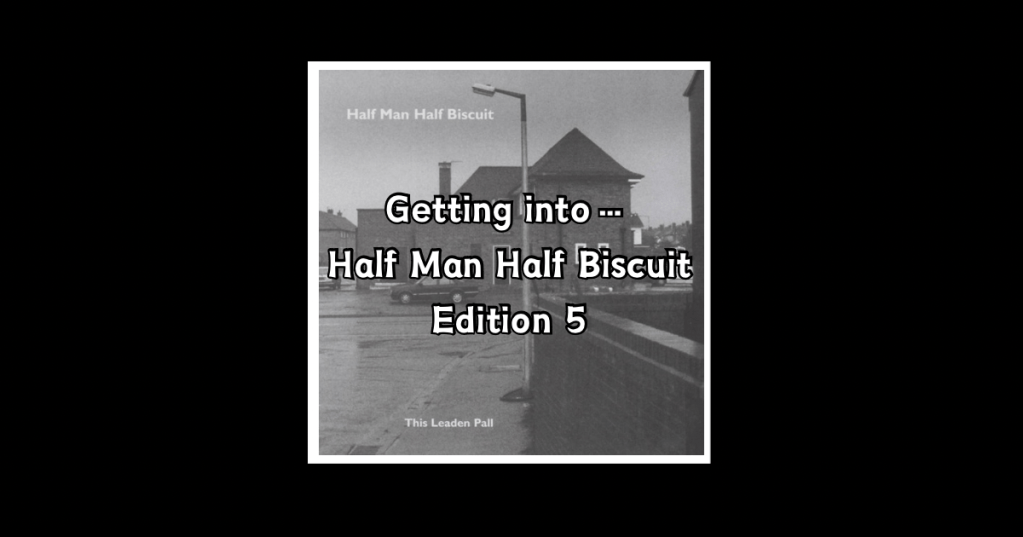
The latest edition of the Getting into series looks at Half Man Half Biscuit’s 4th album, 1993’s This Leaden Pall.
With each listen, I’ve went back and forth on this before settling on the slightly paradoxical conclusion that this is HMHB’s strongest collection of songs so far, yet also somewhat disappointing as an album. But HMHB are a paradoxical kind of band; insights on the human condition masked beneath an onslaught of surrealistic humour, excellently diverse musicianship performed with a rough and ready indifference. And I’ve just realised that their name itself captures their sense of duality; the man and the biscuit representing reality crossed with absurdity, although I’m not sure which is which.
Granted, I’m still barely a quarter of the way through their catalogue, but at this stage I just don’t think HMHB are an “album band”. There’s no sense of their albums being unified pieces of work; they lack any obvious themes and stylistic consistency. What’s frustrating here is that the sense of transition from their previous album doesn’t really materialise. It felt like they were developing a slightly more expansive sound. But most songs on This Leaden Pall wouldn’t feel out of place on any of their previous albums. Rather than a different direction emerging, the expansion just takes the form of a longer album. It’s the sound of a band doing more of the same.
That said, they’re still doing it really well. Across 15 tracks, there’s no outright weak spots, with some real standouts highlighting what they do best. The opener is the musical equivalent of road rage; there’s hints of the Ramones and it’s the hardest, punkiest thing they’ve done since 1986’s Trumpton Riots. 4AD3DCD is them at their catchiest indie-pop best, while being as casually cutting as ever. And the delightfully surreal 13 Eurogoths Floating in the Dead Sea is made even funnier by its surprising melancholia.
As always, there’s new genre experiments, with Footprints being part traditional folk and part eastern psychedelia. And the biggest revelation is Malayan Jelutong, which is dangerously close to a sincerely moving ballad. While it’s typically obtuse lyrically, it turns into their most powerful work yet as Blackwell ponders mortality and the fleeting nature of time.
This is where my frustration really comes in because it often seems like they’re on the verge of a bigger statement on This Leaden Pall, but they never quite commit to it. There’s hints of existential crises lurking over the album, whether it’s the futile drudgery of dead-end work or reflections on faith and religion. But it can feel like these deeper questions are primarily there as elaborate punchline setups. And for as many songs that feed into a common concept, there’s just as many that are irrelevant throwaways; like, did this album really need a takedown of a fictional hipster art student?
Again, this is the paradox of HMHB. And for every piece of criticism or praise I’ve made here, I could easily be convinced that the exact opposite is true. Perhaps those throwaways are just as integral to the message, because the casual exposure of life’s absurdities is what HMHB excel at. One moment you’re questioning the existence of God, the next you’re arguing over which band goes on after Chas’n’Dave on the festival bill. So maybe this is HMHB’s ultimate unified statement after all…
It definitely could have been 3-4 songs shorter though. I hope this doesn’t signal the start of them making unnecessarily long albums.
Rating:

The next edition covers 1995’s Some Call It Godcore. Read it here.
You can catch up on previous editions here.
You can keep up with the latest updates from the blog by following No Frills Reviews on your chosen social media platform.
More Reviews


Leave a comment