
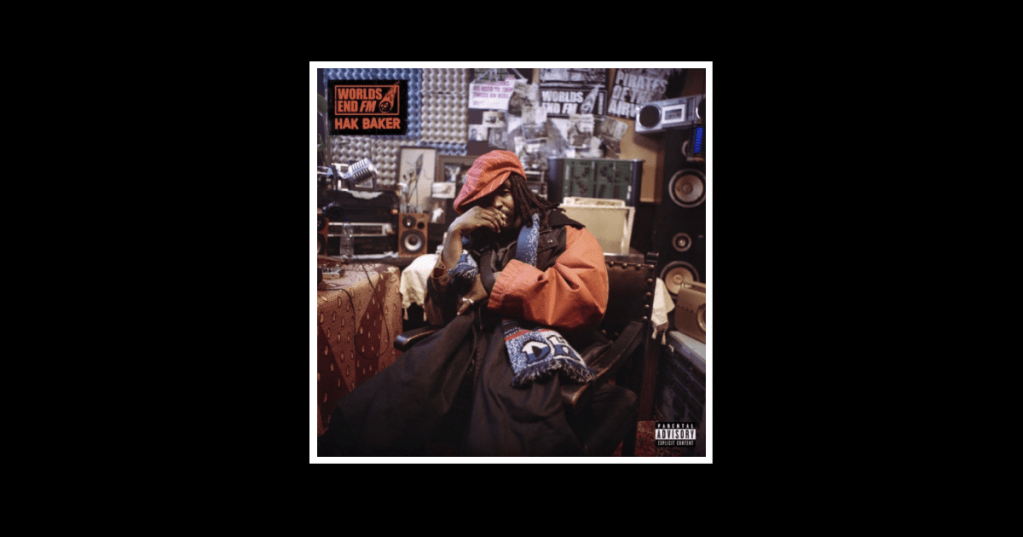
East London songwriter, Hak Baker, has used the term g-folk to describe his musical stylings, a blend of grime and folk. But that feels restrictive. On the evidence here, his style is really whatever he wants it to be at any given moment. The album ranges from gentle acoustic strums to drum ‘n’ bass inspired skits, taking in elements of punk, funk, R&B, and more along the way. It’s genre-hopping, but Baker is never a tourist; it all feels natural. Whichever stylistic direction the album takes, Baker is there to anchor things with a laid-back storyteller’s charm.
The album’s theme also works in this regard; Baker as a radio host playing on as the world ends around him. There’s a series of skits scattered throughout the album and, unusually, they actually work. They help to hold the album together and provide cameo appearances which bring to life Baker’s supporting cast of family and friends. While the album is ostensibly about the end of the world, it’s really about the importance of these relationships; having good times and supporting loved ones in spite of, or rather because of, the world falling apart around you.
While Baker might literally talk of the world ending during the skits, the tales throughout the album reveal this to be metaphoric for the struggles of those around him as their worlds fall apart personally. It could be taken as a political album but Baker never really gets political. He certainly hints at political or wider societal issues; families torn apart following the Windrush crisis, gentrification, the pressures of intense social media scrutiny (complete with Britney Spears reference), but these feel like a distant backdrop. Instead, Baker focuses in on the human impacts, revealing how these issues are intertwined in our lives whether we realise it or not.
Baker excels when he really hones in on a subject, like Brotherhood where he describes feeling like a helpless bystander witnessing a friend struggling with their mental health. He also has a knack for really capturing a mood in certain songs. On DOOLALLY, that’s the relentless, blurry pace of a good night out. And at the other of the spectrum, I Don’t Know is so laid-back it feels like you’re in a daydream.
The strongest tracks here have quite overt messaging or themes. So those tracks with slightly vaguer lyrics suffer in comparison. There’s a few tunes, like the Jamie T-esque Collateral Cause and Bricks in the Wall, which are perfectly well crafted songs, but don’t have the impact of those around them. Later on, Dying to Live and Almost Lost London are a bit too close tonally, which causes them to run together slightly. The album’s pacing would have benefited from losing a couple of tracks off the length.
Those are nitpicks though in what is a fine effort for the most part, with multiple stand out moments. In particular, closing track, The End of the World, really does feel like the culmination of everything that comes before it, driving home the album’s message as it tackles some of its heaviest subject matter in suicide, grief, and mental health. The song brings together one of the aforementioned cameos with a lullaby-like ode to looking after one another. It’s the kind of thing that could come off cheesy out of context, but it feels completely sincere and the moment is earned by what precedes it. And it really solidifies Baker’s role here, he isn’t just a storyteller, he’s the curator for the stories of those around them. And this feels like his gift to them for letting him be a part of those stories.
Rating:
Best tunes: DOOLALLY, Windrush Baby, I Don’t Know, The End of the World
Note – this review was originally published in June 2023 as part of a new music roundup post. It has been re-published separately here for archiving purposes.
More Reviews
Fine Art
Being Poor is Expensive


Leave a comment